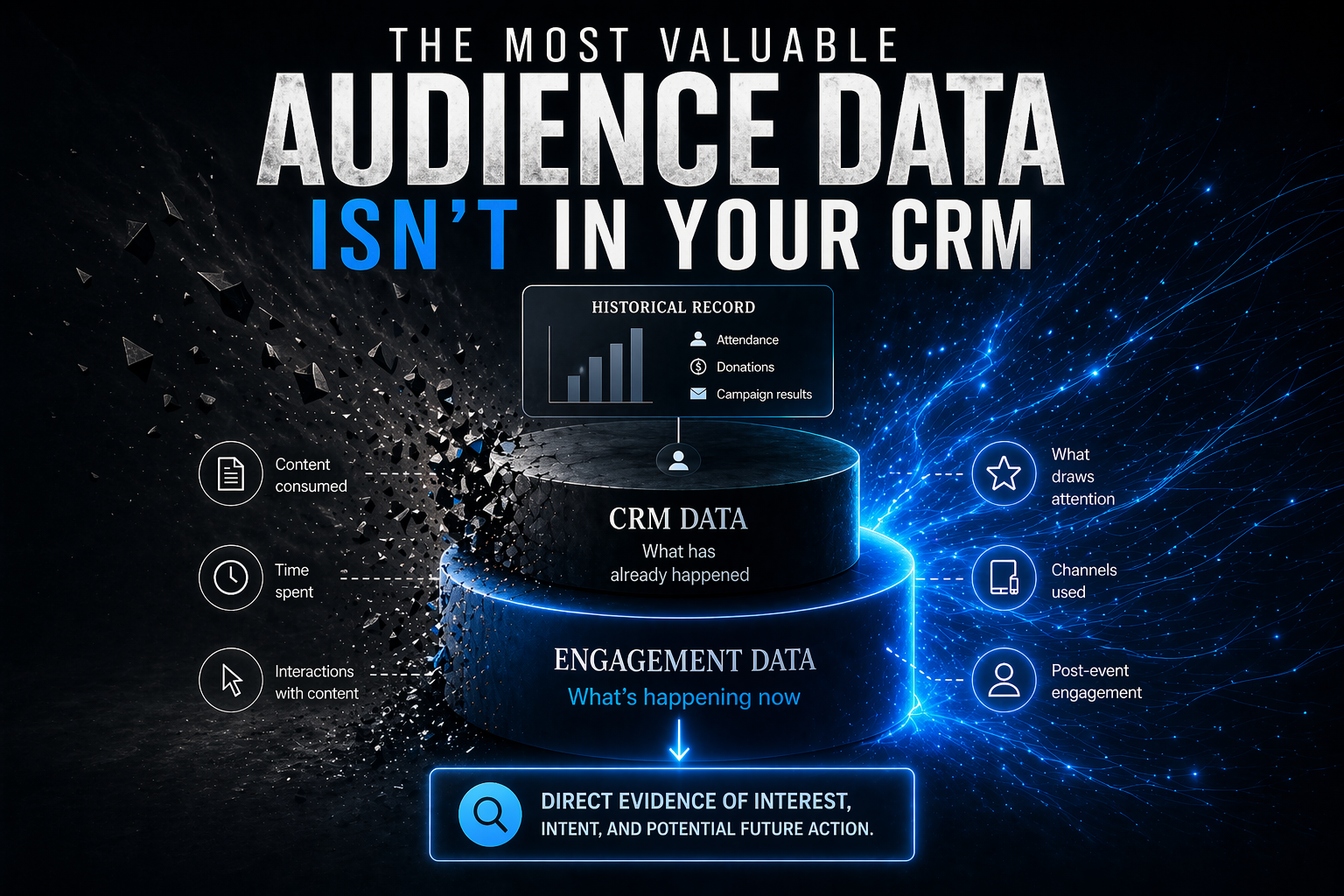
For many arts organizations, the CRM sits at the center of audience strategy.
It holds ticket buyers, donor records, campaign history, and years of accumulated institutional knowledge. It is the system teams rely on to understand their audience, guide outreach, and report on performance.
And it plays an essential role. But it was not designed to capture everything.
What CRMs Do Well
Customer relationship management systems are built to track transactions and relationships over time. They provide structure around who has purchased, donated, or engaged in a measurable way, and they allow organizations to organize that information into usable segments.
This historical record is valuable. It supports fundraising, informs marketing campaigns, and provides continuity across seasons. But it reflects what has already happened.
Where the Picture Becomes Incomplete
What CRMs do not capture well is behavior.
They show that someone attended a performance, but not what they engaged with once they arrived. They record that a ticket was purchased, but not whether that attendee explored program content, showed interest in specific initiatives, or interacted with sponsor messaging.
In many cases, they also capture only the buyer, not the full audience present in the venue.
As a result, organizations are often making decisions based on a partial view. They can see transactions clearly, but the layer of insight that explains why those transactions happen—and what might happen next—remains largely invisible.
The Missing Layer: Engagement
Audience engagement is where much of the untapped value exists.
It is reflected in what patrons choose to read, where they spend time, what draws their attention, and how they interact with the organization’s content during and after a performance. These behaviors are not hypothetical—they are observable signals that reveal interest, intent, and potential future action.
Without this layer, organizations are left to infer meaning from outcomes. Attendance, donations, and campaign results become proxies for understanding, rather than direct evidence of what audiences actually care about.
Why This Gap Matters More Now
In a more stable environment, historical data alone could carry much of the decision-making load. Past behavior was often a reliable indicator of future performance, and long-standing audience patterns changed gradually.
That environment has shifted.
Audience expectations are evolving. Attendance patterns are less predictable. Competition for attention is increasing. In this context, relying solely on historical data makes it more difficult to respond with precision.
Organizations need to understand not just who their audience has been, but how that audience is engaging right now.
From Systems of Record to Systems of Insight
The opportunity is not to replace the CRM. It is to extend it.
When a behavioral layer is introduced—one that captures engagement alongside identity—the audience picture becomes more complete. Transactions remain important, but they are no longer the only signal informing decisions.
This shift moves organizations from maintaining a system of record to developing a system of insight.
Instead of asking only “Who attended?” teams can begin to answer more meaningful questions:
What resonated?
What held attention?
What should we do more of next?
These are the questions that shape strategy, not just reporting.
What a More Complete View Enables
When identity and engagement are connected, decision-making becomes more grounded.
Marketing can move beyond broad segmentation and focus on demonstrated interest. Development can identify potential supporters based on engagement, not just giving history. Leadership can evaluate performance based on how audiences are interacting, not just how many attended.
The data does not become more complex. It becomes more useful.
The Bottom Line
CRMs remain a critical part of the infrastructure.
But they were never intended to capture the full depth of audience behavior.
The most valuable audience data—the signals that explain interest, engagement, and intent—often exists outside of them.
Organizations that recognize this are not abandoning their existing systems. They are building around them, adding the missing layer that turns historical records into actionable insight.
Because understanding who your audience was is important.
But understanding what they care about now is what drives what happens next.
If you’re starting to think about how audience data could be more complete—not just historical, but behavioral—it’s worth seeing what a more connected approach can look like in practice. You can check it out here.