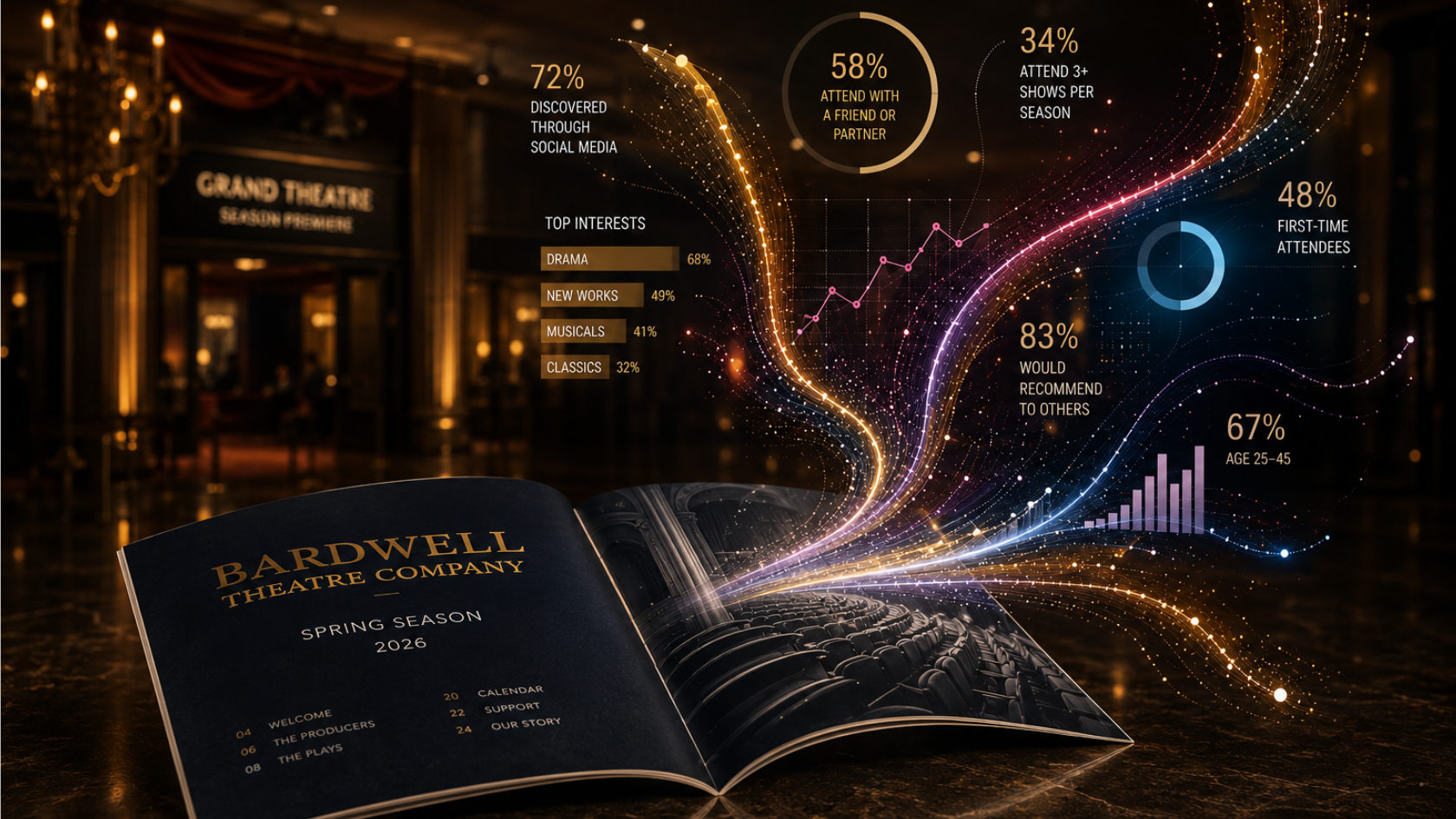
The program book is one of the highest-intent audience touchpoints your organization has. It reaches patrons at the exact moment they are most engaged: while they are physically present, focused on the performance, and actively participating in the experience your organization has created.
It is often viewed as a necessary operational deliverable—important, visible, and expected. That perspective is understandable, but it is also incomplete.
Because the program book is not just a publication. When print and digital work together strategically, it becomes far more than an audience guide—it becomes a source of audience intelligence.
Why Hybrid Publishing Creates More Than a Better Patron Experience
For years, the conversation around hybrid publishing has focused primarily on convenience and cost. Reduce print pages. Lower production expenses. Move extended content to digital. Improve accessibility. Modernize the patron experience.
Those are real benefits, and they matter. But they are only the surface-level advantages.
The larger opportunity is that hybrid publishing creates visibility.
A printed program delivers the experience, but it cannot tell you what happened after it was handed to the patron. It cannot show which sections were most valuable, what content held attention, or whether sponsor messaging created meaningful engagement. Once it is distributed, the feedback loop ends.
A frictionless digital companion changes that dynamic entirely. When patrons access content digitally—through a QR code, text message, or direct mobile access—the organization begins to see how audiences actually interact with the content. It becomes possible to understand what sections are most viewed, which sponsor placements drive clicks, how long patrons engage, what donor messaging resonates, and whether audiences return after the performance.
That is not simply better publishing. It is operational intelligence.
Print Still Matters—But It Cannot Personalize
Print remains valuable for reasons that should not be ignored. It creates permanence, reinforces brand quality, and provides the polished in-hand experience that many patrons still expect and appreciate. It supports donor visibility, sponsor recognition, and the physical presence that remains an important part of live performance culture.
But print is static.
Every patron receives the same experience, regardless of what matters most to them. There is no adaptability, no personalization, and no measurable behavioral feedback. It informs the audience, but it cannot respond to them.
That limitation matters more as audience expectations continue to shift. Today’s patrons are accustomed to curated experiences in nearly every other part of their lives. Streaming platforms recommend based on behavior. Retail experiences personalize offers. Communication feels increasingly tailored to individual relevance.
Static publishing cannot deliver that alone.
That does not make print obsolete. It makes digital essential.
Where the Real Data Lives
The strongest audience signals rarely come from annual surveys or post-event reports alone. They come from behavior in the moment—while patrons are actively engaged with the experience itself.
What they choose to read. Where they spend time. What they click. What they ignore. What they return to later.
These are not opinions. They are decisions.
And those decisions reveal more than attendance reports ever can.
They show where loyalty is forming, where donor potential may exist, which sponsor relationships have real value, and what parts of your mission create the strongest audience connection. This is the kind of information that improves future decisions because it reflects actual behavior rather than delayed recollection.
Your audience is already telling you what matters, but most organizations are simply not structured to hear it.
Why This Matters for Sponsors, Donors, and Retention
When program books move from static publications to engagement systems, their strategic value expands quickly.
Sponsors no longer receive visibility alone—they receive measurable performance. Instead of promising impressions, organizations can demonstrate interaction, attention, and real audience response. That creates stronger renewal conversations and allows sponsorship packages to be positioned around value rather than placement alone.
Development teams gain stronger signals around loyalty and future giving potential. Repeat engagement often reveals donor readiness long before a formal contribution is made. The patron who consistently engages with mission-driven content may represent more long-term value than the one-time donor whose name only appears in a report.
Marketing teams gain something equally important: clarity. Instead of relying on broad assumptions about what resonates, they can see which messaging drives engagement and which audience behaviors predict retention.
Leadership gains confidence because decisions move from assumption to visibility.
That changes how organizations plan.
The Program Book as Infrastructure
This is where many organizations underestimate the role of the program book.
It is not simply a seasonal project. It is infrastructure.
It sits at the intersection of audience engagement, sponsorship, donor recognition, brand experience, and patron communication. It is one of the few places where nearly every attendee interacts with your organization at the moment of highest attention—while they are physically in the seat and fully immersed in the experience.
That moment matters.
And when it is structured correctly, it becomes one of the most powerful audience intelligence opportunities in the building. Not because the technology is complex, but because the audience intent is already there.
The opportunity already exists.
The structure is what determines whether it creates value.
The Bottom Line
Hybrid publishing is not just about reducing print costs or adding digital convenience. It is about turning a required publication into a strategic asset.
Print preserves the experience. Digital creates the intelligence.
Together, they create something far more valuable than either could alone: a system that improves the patron experience while helping the organization understand its audience more clearly. The program book stops being just an output and starts becoming part of the operating model itself.
The program book is already one of the most important audience touchpoints your organization has.
The question is whether it is only delivering information—or also creating insight.
If your program book is still functioning primarily as a printed deliverable, it may be worth exploring what happens when it becomes part of a broader audience strategy.