When program book production starts to feel stressful, the first instinct is often to blame the wrong part of the process.
-Design took too long.
-The printer needed more time.
-Last-minute edits created chaos.
-The vendor was not responsive enough.
Those issues are visible, so they are easy to identify. But in most cases, the real bottleneck begins much earlier. It starts with approvals.
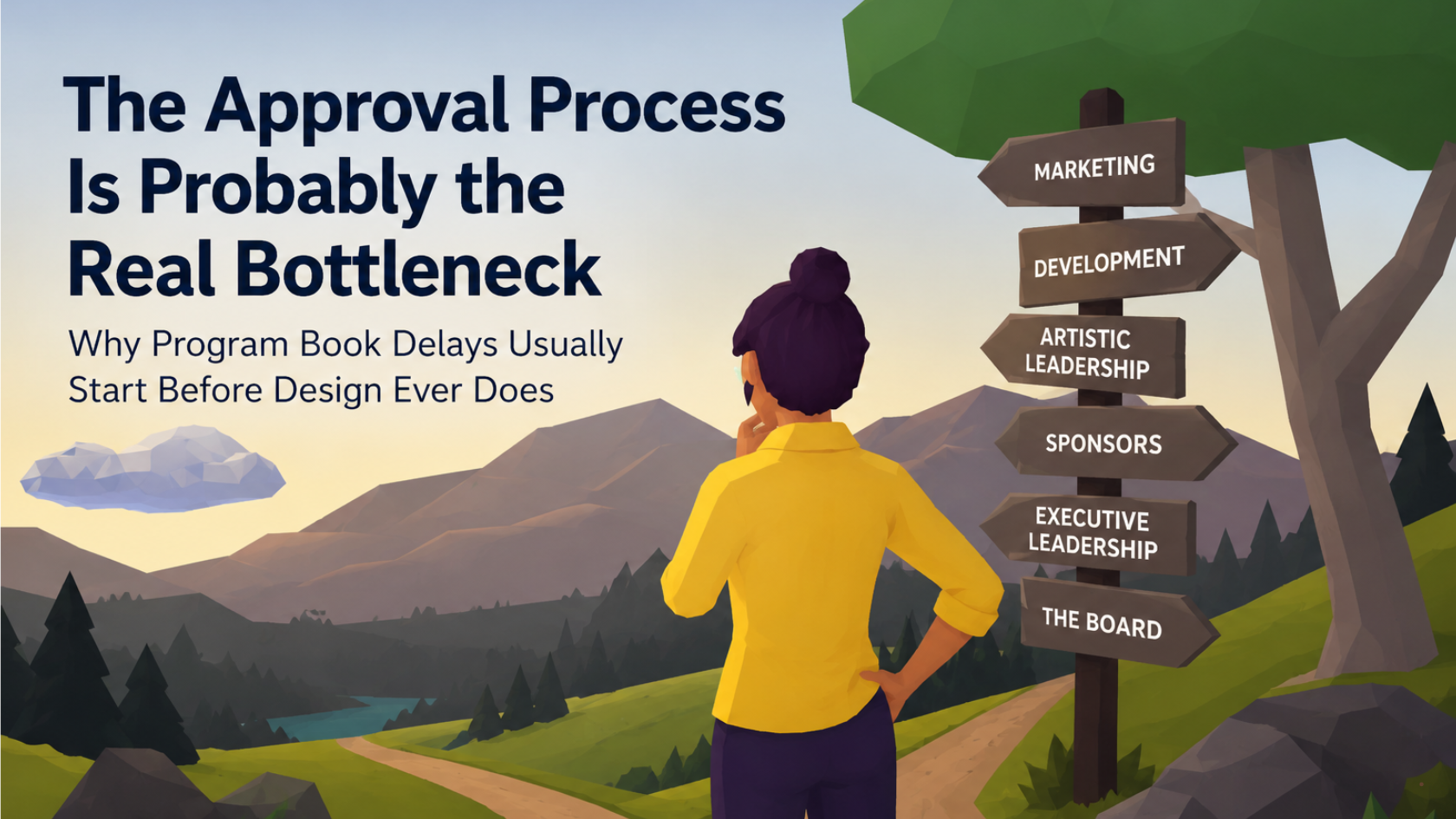
Before a single file is finalized, the program book has often moved through marketing, development, artistic leadership, sponsorship, executive leadership, and sometimes even the board. Each group has valid input. Each group is protecting something important.
The problem is not collaboration. The problem is collaboration without structure.
Why Too Many Reviewers Create Delays
Program books sit at the intersection of multiple departments, which makes them uniquely vulnerable to slow decision-making.
Marketing is shaping messaging and layout. Development is reviewing donor recognition and acknowledgments. Artistic leadership is focused on content accuracy. Sponsorship teams are managing advertiser commitments. Executive leadership wants brand consistency and risk control.
Everyone has a legitimate reason to be involved. But when ownership is unclear, review becomes endless.
A proof is sent. Feedback comes back. Another stakeholder adds changes. A final review becomes another round of revisions. Small edits trigger new approvals, and “just one more change” quietly becomes the reason deadlines begin to slip.
The issue is rarely proofing itself. It is proofing without boundaries.
When Collaboration Turns Into Operational Drag
Collaboration is valuable. Undefined collaboration is expensive.
The longer a program book moves through open-ended review cycles, the more operational drag builds around it. Staff spend time chasing approvals instead of moving the project forward. Designers make revisions that are later reversed. Vendors are forced into compressed production timelines because decisions happened too late upstream.
What feels like caution often creates more risk.
Late approvals increase the chance of mistakes, rushed decisions, and unnecessary reprints. They also create internal frustration because no one feels fully responsible, yet everyone feels delayed by someone else.
This is where many organizations mistake involvement for control.
In reality, too much approval often reduces both.
Why Centralized Proofing Changes Everything
The strongest program book workflows do not eliminate collaboration. They structure it.
Clear reviewer paths, defined deadlines, and a single proofing channel create predictability. Everyone still contributes, but not all at once and not without ownership.
This is why centralized proofing matters.
When all revisions move through one controlled system, version confusion disappears. Teams are not searching through email threads for the latest file. Stakeholders know where feedback belongs. Final authority becomes clear.
Instead of managing multiple disconnected review paths, the organization operates from one source of truth.
That is where speed improves—not from working faster, but from removing unnecessary friction.
Why Hybrid Publishing Reduces Approval Pressure
This is also where the value of a strong digital companion becomes clear.
Traditional print programs create pressure because every detail feels permanent. Once files go to press, corrections become expensive and mistakes feel final. That often drives even more review cycles as teams try to eliminate every possible issue before approval.
A frictionless digital companion changes that dynamic.
Updates, corrections, extended content, and late adjustments can be handled seamlessly through digital without disrupting the print schedule. Donor updates, artist changes, sponsor additions, and supplemental information no longer need to create panic at the printer deadline.
This does not reduce quality. It improves flexibility.
Print remains the polished in-hand experience. Digital becomes the responsive layer that supports updates, gives depth, and creates ongoing audience engagement.
Together, the hybrid model reduces pressure on approvals because not every decision has to be treated as irreversible.
That creates a stronger operational system and a better patron experience at the same time.
The Goal Is Not More Review—It Is Better Control
Many organizations assume more approvals create better outcomes.
Usually, they create slower ones.
Quality does not come from adding more reviewers. It comes from creating clear responsibility, stronger process design, and a publishing model built to absorb change without creating disruption.
The goal is not to remove collaboration. It is to remove unnecessary friction.
When approvals are structured properly, deadlines improve, staff regain time, and the final product becomes stronger because the process behind it is stronger.
That is not just better publishing. It is better operations.
The Bottom Line
Most program book delays do not begin in design.
They begin long before that—in unclear approval paths, too many reviewers, and proofing systems built around reaction instead of structure.
The strongest organizations are not the ones with the most oversight. They are the ones with the clearest process.
Because when approvals are controlled, everything downstream improves.
And when print is supported by a frictionless digital companion, the entire publishing model becomes more flexible, more efficient, and far easier to manage.
If your current program book process feels heavier than it should, the issue may not be the work itself—it may be the structure around it.
Clear ownership, centralized proofing, and a stronger balance between print and digital can remove significant operational friction without changing the audience experience.
Seeing what that looks like in practice is often the best place to start: Onstage Managed Program Book Services.