For years, arts marketing has been built around reach.
Larger email lists. Broader audience segments. Wider geographic targeting. More campaigns designed to put the same message in front of as many people as possible. The assumption has been straightforward: if enough people see the message, enough people will respond.
That model made sense when visibility was the primary challenge.
But today, visibility is rarely the problem. Attention is.
Audiences are surrounded by constant communication—emails, texts, social media, subscriptions, recommendations, and constant digital noise competing for the same limited focus. In that environment, simply increasing the volume of communication rarely creates stronger relationships. More often, it creates more noise.
The issue is not whether the message is being delivered.
It is whether the message feels personally relevant.
That distinction is becoming one of the most important strategic shifts in arts marketing.
Why Traditional Messaging Often Falls Short
Many performing arts marketing strategies still begin with the performance itself.
The season announcement highlights the repertoire. Campaigns focus on the guest artist, the conductor, the title of the production, or the prestige of the work being presented. The assumption is that the product should do the work of creating interest.
And for a portion of the audience—particularly long-time subscribers and highly engaged patrons—that may be enough.
But for a growing share of attendees, especially newer audiences and less frequent buyers, the first question is not “Who is performing?”
It is, often unconsciously, “Why does this matter to me?”
That question is far more personal.
Some patrons are looking for a night of escape and restoration. Others are seeking time with family, cultural exploration, learning, inspiration, or simply a meaningful reason to leave the house. These motivations are emotional and practical before they are artistic.
When marketing begins with the product instead of the patron, relevance becomes harder to establish.
And without relevance, even strong programming can struggle to convert attention into action.
Print Alone Cannot Deliver Curated Relevance
This challenge is especially clear in the traditional program book model.
Print is valuable. It creates permanence, supports branding, and delivers a polished in-hand experience that many patrons still expect and appreciate. It plays an important role in the overall audience journey.
But print is static.
Every patron receives the same content, in the same order, with the same experience regardless of what actually matters most to them. It cannot adapt to individual behavior, interest, or intent. It informs, but it does not personalize.
That limitation matters more as audience expectations continue to shift.
Today’s patrons are accustomed to curated experiences everywhere else—streaming platforms recommend content based on behavior, retailers personalize offers, and even news feeds adjust based on demonstrated interest. Static communication feels increasingly disconnected from how people naturally consume information.
This is where digital changes the equation.
When Print and Personalized Digital Work Together
The strongest publishing strategies are no longer built around choosing between print and digital.
They are built around using each for what it does best.
Print delivers credibility, structure, and the in-venue experience. It handles essential information, high-value editorial, and the physical touchpoint that many organizations and patrons still value.
Digital adds flexibility, depth, and—most importantly—the ability to create relevance.
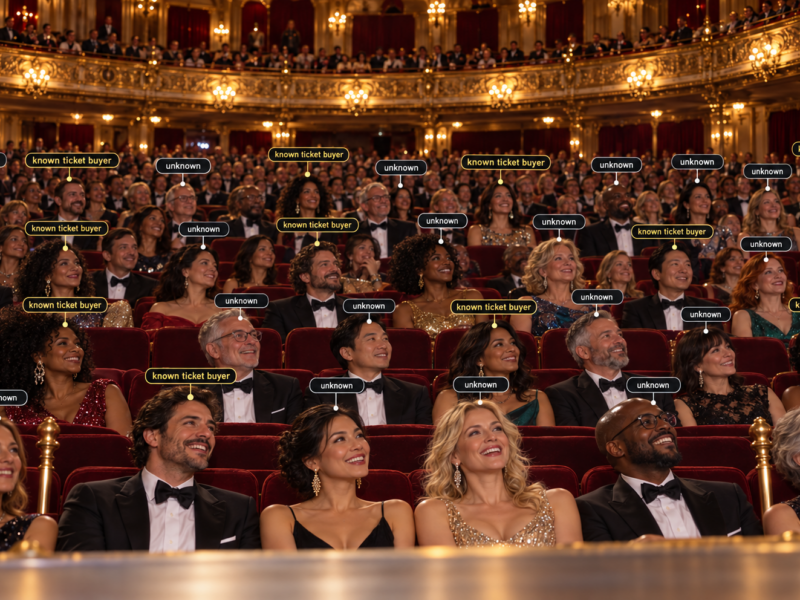
Extended content can be accessed on demand. Audience behavior becomes measurable. Follow-up communication can be shaped by what patrons actually engaged with instead of broad assumptions. Future messaging can reflect demonstrated interest rather than generic segmentation.
This is where the model changes from publishing information to building audience intelligence.
A strategically executed combination of print and personalized digital does not replace the patron experience.
It improves it.
And over time, it fundamentally changes how organizations market, retain, and grow their audiences.
The Future Is Curated, Not Broadcast
The organizations creating stronger audience growth are moving away from broad communication strategies and toward curated relevance.
Instead of treating audiences as large, generalized groups, they are beginning to understand them as individuals with different motivations, behaviors, and patterns of engagement.
Some are looking for family experiences. Others care most about educational programming, donor impact, or community connection. Some return because of artistic loyalty. Others return because the overall experience feels personally meaningful.
The performance is still the product.
But the pathway to that product begins with personal relevance.
That is where audience engagement is headed—not toward more communication, but toward more precise communication. Not broader messaging, but more intentional experiences built around what each patron actually values.
That level of personalization does not happen through better assumptions.
It happens through better audience visibility.
And increasingly, that visibility is becoming the real competitive advantage.
If you are rethinking how your organization builds audience relationships, it is worth considering whether your current systems are helping you create real connection—or simply helping you communicate more.
Seeing what a more connected approach looks like in practice is often the best place to start.
Explore here how print and digital can work together to create stronger audience engagement.